Meeting Enrollment Goals Part 1: The 72-Hour Rule and the 80/20 Rule

Meeting Enrollment Goals Part 1: The 72-Hour Rule and the 80/20 Rule

ISSUE 15

Meeting Enrollment Goals Part 1: The 72-Hour Rule and the 80/20 Rule

By Jim Pearson and Dr. Scott Massey

Welcome back to PA Admissions Corner. Let’s continue making the most of your PA program’s admissions with time-tested and proven knowledge on meeting enrollment goals.

Your Conversion Ratio and the Funnel

When a completed application reaches your PA program, it joins many others. Then they enter a funneling system en masse where the numbers steadily decrease as selections are made. It would be great if all the funneling were done by your program, but your applicants are funneling, too. Both ends of the funnel have a say in who’s going where.

The steps of the funnel and who is in control of them goes something like this:

  1. How many applications your program receives (applicant’s choice)
  2. How many individual interviews are offered (program’s choice)
  3. How many of those offered interviews are accepted (applicant’s choice)
  4. How many acceptance letters are sent (program’s choice)
  5. How many acceptance letters are accepted (applicant’s choice)
  6. How many accepted acceptance letters result in a seated student (applicant’s choice)

Two-thirds of those funneling steps are not in your control. It turns out that what you do with the applications isn’t as important as what you do with the applicants. Applicants seeking a PA education apply to an average of seven programs besides yours. Going strictly by the numbers, those odds aren’t in your favor. We want to make sure that you spend time on the students who truly want to be a part of your PA program, not the ones who have other goals in mind. Once you find the truly interested applicants, you can’t let yourself lose them to a program that moved faster or made a better impression.


Two Rules for Improving Your Conversion Ratio

PA program admissions directors and faculty play a key role in whether students decide to deposit after being selected for a seat in the program. The way communication occurs and the timing of that communication can make the difference between converting those applicants best aligned to your PA program’s mission and vision or losing them to other programs due to ineffective and inefficient communication.

Keeping these excellent applicants “warm” is essential. This requires thoughtful and ongoing communication with your ideal applicants throughout the admissions process. Most applicants report that their most preferred PA program to attend is based on the perception of responsiveness and excellent communications from the PA program’s key personnel, not just support staff.

Here are a couple of vital rules to follow to ensure you will enroll a higher proportion of the ideal applicants that fit your PA program’s mission and vision.


The 72-Hour Close

Coffee is for closers. You’ve done interviews, and some of those applicants were impressive. Everything clicked. They love the program, and the program loves them. Send an acceptance letter within 72 hours! Failing to keep applicants interested in your PA program after the interview is why so many PA programs lose those applicants to competing programs. Prospective applicants will not spend the money and time to come to an interview if they are not at least somewhat interested in attending your institution. A lack of communication from your program will be interpreted as a rejection or non-caring attitude, however, and that applicant’s interest might drift away.

Have a backup plan. Sometimes it’s just not possible to offer applicants seats after the interview and final selection within 72 hours. This may be due to holidays, weekends, and other workflow that can all place burdens on timing and proper follow-up. If this happens, make sure that you reach out to the applicant to tell them that the decision is coming very soon. Continue to show to the applicant your program’s commitment. Keep in touch with them and keep them informed that they are still in strong consideration.

Don’t forget the waitlist. It is also wise to foster a strong and consistent positive relationship with applicants on your waitlist to ensure that they are poised and ready to enter your program, even at the last minute. As statistics have shown, many programs experience last-minute withdrawals, and without a strong waitlist, those programs cannot fill their seats—revenue loss that must be avoided.

Your relationships with your qualified applicants and waitlist throughout the applicant and interview process is a reliable insurance policy that your class will be full on the first day of orientation.


The 80/20 Rule

If you want to be a successful PA program admissions director, understand this rule: 80% of your matriculating students each year come from only 20% of your prospects.

Up to 35% of your applicants, even including pre-enrolled students, may be using your program as a backup plan if their first or second choices fall through, which makes identifying the correct 20% of your ideal applicants so imperative. These prospective applicants are just as interested in staying in the funnel as you are in having them stay. Find these applicants and devote your energy to them: don’t waste time chasing those who have little intention of following through.

Who are your ideal applicants? We mention these unicorns often, so let’s break down exactly who they are:

  • Most likely, these are the applicants within 100 miles of your campus.
  • They have some connection to your university or attended undergraduate programs at your institution.
  • They fit your average GPA and other base requirements.
  • They have reached out to you at some point expressing significant interest in your school, and they continue to express interest as time passes—another reason why early and dedicated communication is so valuable.
  • They are familiar with your program—a strong indicator of potential conversion.
  • They respond promptly to your communications.

It’s mostly a matter of your program’s time resources. PA admissions personnel who chase down prospects that won’t make a clear early commitment are wasting 50-70% of their time and the time your program has to allot to the process. They’re trying to convince students who are not sold on the idea of joining your program, and no matter how savvy the salesperson, most of those applicants never will be sold on it.

Instead, devote your resources to the prospects who show their conviction. That’s the measure of how serious they are. Recognizing those applicants early in the recruiting process will give you more time to locate and work with them. They have the highest chance of enrolling and matriculating in your PA program, so they are worth the time spent.

The bottom line of the 80/20 rule is simple; work with the prospects who work with you


Conclusion

The PA admissions paradigm will transform in coming years, requiring more of a recruiting mindset than ever before. You will need to foster relationships and identify your ideal applicants. Through successful selection and a 72-hour communication turnaround, you exponentially increase the likelihood of these applicants depositing and matriculating at your program.

In future Issues, we’ll cover handy techniques that can help determine who your ideal applicants are, like the applicant pre-enrollment risk scoring program. We teach entire seminars on this stuff! We’ll show you how to efficiently separate the good prospects from the bad.


NEXT TIME…
In Issue 16 of PA Admissions Corner, we’ll finish this two-parter on meeting your program’s enrollment goals. We’ll provide answers to some of the most common questions PA program directors have asked us about meeting enrollment goals, such as what to do if—
• applicants are scarce.
• applicants are plentiful, but goals are still being missed.
• conversion rates seem to fall lower each year.
• there are unexpected empty seats at the eleventh hour.


To your admissions and program success,

Jim Pearson, Former CEO
Exam Master

Dr. Scott Massey Ph.D., PA-C
Scott Massey LLC

Exam Master partners with PA programs by:

For information on any of the above products and/or services, contact us.

Meeting Enrollment Goals Part 1: The 72-Hour Rule and the 80/20 Rule

Meeting Enrollment Goals Part 2: Common Questions

ISSUE 16

Meeting Enrollment Goals Part 2: Common Questions

By Jim Pearson and Dr. Scott Massey

Welcome back to PA Admissions Corner. In the previous Issue, we began this two-part series on meeting your enrollment goals with our 72-Hour Rule and 80/20 Rule. Now, we conclude by answering the questions PA educators ask us most often about the difficulties they face in meeting their enrollment goals.

As you know, meeting your PA program’s enrollment goals is more than placing ads, interviewing applicants, and matriculating selected students. You need a dedicated and focused approach to ensure that your PA program is structured to recruit, screen, and enroll highly qualified students. Depending on the structure and management of their admissions departments, PA programs may be competing on a lopsided playing field. Fortunately, PA programs everywhere struggle with similar issues in ensuring that their class rosters are full at the beginning of the cohort and all the way through to successful graduation.


Question: Why do some PA programs struggle to enroll 24 or 36 students per cohort, while others can always hit their numbers?

Make sure that you have aligned the timing of your admissions cycle to enable your admissions department to communicate with the largest percentage of applicants, alongside most other PA programs. This can be achieved by:

  • Running an admissions cycle from April to October
  • Using a rolling admissions cycle
  • Interviewing early in the admissions cycle
  • Sending acceptance letters early in the admissions cycle

For more detailed information on all of these strategies, look back to PA Admissions Corner Issue 3: Controlling the Admissions Cycle.

Your admissions department must always target the applicants who fit your program’s unique characteristics. Doing so is a significant factor in ensuring your PA program’s admissions enrollment goals are met.


Question: Why is it so hard to achieve enrollment goals even with abundant applicants?

Successful applicant enrollment results from a series of relationship-building steps, from the moment a prospective student submits their application until the day of matriculation.

How can this relationship be fostered?

  • Early and sustained communication is paramount. Evaluate your communication process from the time of application submission through the interview process to foster a strong connection with the prospective student.
  • Provide opportunities for interaction between the program director and prospective students.
  • Include current students in the process. Their inside viewpoint can be invaluable to applicants.

Every applicant has an affinity group—support systems, friends, and family —who play a role in their decision, and it is naive to assume the opinions of the affinity group won’t matter. Without moving the focus away from the applicant, include the affinity group in the communication process.

  • Offer resources to support relocation to the area.
  • Promote a family-friendly atmosphere in your program by welcoming the affinity group into the selection process.
  • Add a step in the interview process that allows the affinity group to speak with a faculty member, a financial representative, or even the program director.


Question: Why does our conversion rate from offer to matriculation seem lower each year?

Conversion rate is the percentage of applicants offered seats in your program who eventually matriculate. This percentage fluctuates considerably among programs, and there are strategies that can mitigate this variable.

By the end of their interview with your program, an applicant has most likely made up their mind whether or not they will enroll. You are going to need to ask yourself some hard questions about whether your interview process was disorganized or left the applicant feeling unwelcome. It will require some deep self-assessment. Here are some strategies that can help with this issue:

  • Evaluate your interview process. It is strongly suggested that applicants get the opportunity to meet with the program director in person or virtually, depending on the circumstances. Create a segment in the interview process called, “Q&A with the Program Director.”
  • Evaluate the length of time between the interview and the acceptance offer. Allowing too much time to pass will result in competitive applicants receiving competing offers.
  • Consider offering the most competitive applicants an immediate seat in the program. Their application and interview are so impressive that accepting the applicant is practically assumed. Why wait? Ensure that the applicant receives correspondence via email within 72 hours. These applicants are likely to have multiple options. Don’t lose them to other programs!
  • Consider whether the applicant feels informed and feels like they have been heard throughout your interview process. Or, did they leave the interview process with an uncomfortable feeling that they were put under a microscope or rushed out the door? If applicants perceive that you are indifferent to them, they will decide that your program is not the right fit. Find ways to make applicants feel welcome and able to ask questions about the program in an open and relaxed setting. Always remember that an applicant is interviewing you as much as you are interviewing them.


Question: Why can’t we fill our cohort, even though we are getting hundreds of applicants?

Programs that find themselves unable to fill their cohort despite receiving hundreds of applications most likely haven’t figured out how to manage the required human resources to operationalize an effective admissions process.

Primarily, your program must have the necessary human resources to cope with the volume of applications. For more information, see Issues 12 through 14 of PA Admissions Corner, where we discuss ways to solve the troubles of an overworked or understaffed admissions team.

You might also be wasting time interviewing applicants who have no intention of attending your program. Properly identifying the best applicants for your program from the outset can save much of this wasted time.


Question: By the time we reach out to interview applicants, they already have been selected elsewhere. How can we reach out to them first?

Fine-tune the steps in your admissions process and improve your image. Poor public relations or a disorganized interview process can adversely affect applicant perception of your program. A streamlined, student-centered admissions process will reduce the likelihood that another program will appear more attractive.


Question: How can we fill empty seats at the last minute without sacrificing applicant quality?

To fill empty seats in the last weeks before matriculating, scour the existing applicant pool for any quality applicants who can still be fast-tracked into the system. Consider a truncated admission cycle in the weeks leading up to matriculation while maintaining your standards of admission, then arrange a virtual interview.

Once a student has accepted a seat in the program, your University Financial Aid Department has to expedite their financial aid package at a moment’s notice if you’re already in the home stretch. Spare no expense to avoid an angry Dean who asks why your seats are not filled on the first day of class.


Question: How do we fill a cohort with a shallow applicant pool?

Some programs find themselves with a smaller number of applicants than the national average, especially new or developing programs accepting their first or second cohort.

You can still manage, but you have to max out on applicant outreach and incorporate all of the strategies we have discussed so far. These applicants need to be fostered and convinced that your program is the best solution. It’s especially necessary in this situation to move to a rolling admissions process so you can communicate and work with all your qualified applicants early and often.


Conclusion

Every empty seat in your cohort is a lost tuition revenue for one student, which can seriously impact your PA program’s budget. There are close to 12,000 seats nationally available for PA programs every year, and more than 34,000 applicants. With these numbers, no PA program should have empty seats on day one.

By promoting a focused mission for your admissions team, improved communication with applicants, prompt acceptance, fast-tracking ideal applicants, and increased outreach when necessary, you are doing the utmost to fill your cohort with students who are happy to be a part of it.


NEXT TIME…
In Issue 17 of PA Admissions Corner, we’ll begin a five-part series on Successful PA Admissions, covering several topics on filling your cohorts with students who match your program’s mission and vision. forget an in-depth look at finding your ideal applicants, behavioral and group interviewing, and expanding the diversity and inclusiveness of your program.


To your admissions and program success,

Jim Pearson, Former CEO
Exam Master

Dr. Scott Massey Ph.D., PA-C
Scott Massey LLC

Exam Master partners with PA programs by:

For information on any of the above products and/or services, contact us.
Meeting Enrollment Goals Part 1: The 72-Hour Rule and the 80/20 Rule

Successful PA Admissions Part 1: Finding and Enrolling Your Ideal Applicant

ISSUE 17

Successful PA Admissions Part 1: Finding and Enrolling Your Ideal Applicant

By Jim Pearson and Dr. Scott Massey

Welcome back to PA Admissions Corner. This Issue begins a five-part series we’ve really been looking forward to: Successful PA Admissions.

Of course, all issues of PA Admissions Corner have been about this subject in one way or another. What’s different? Now we’re breaking it all down for you. We’re going to tell you who your ideal applicants are and, more importantly, how you can distinguish them from your applicant pool. When you find them early, you can focus your time and efforts on these sometimes-hidden gems.

In today’s Issue, we’ll look at the “who” and in the next four Issues, we’ll talk about “how.”


A hard truth in admissions is that you can always lose potential matriculants, even during the last few days before classes begin. Why is this? Applicants who decide not to attend your PA program at the last minute usually found enrollment with a program that met more of their individual needs or wants.

When this happens, rest assured that these losses were not your ideal applicants.

Well, that’s easy to say in hindsight, isn’t it? And it sounds a little bit like a coping mechanism. “Oh, if they didn’t attend our program, they must not have been right for us.”

What we have found and what we want to convey to you, however, is that there are ways to identify those ideal applicants well ahead of time so that last-minute changes are minimized. Your staff can spend their time focused on the applicants that matter: the ones who want to attend your program and who are motivated to succeed when they do.


What are the Applicants Looking For?

Every PA program has a unique set of characteristics and offerings that inform an applicant’s decision. We have spoken with PA students who chose one program over others, and we learned the factors that have the greatest weight in their decision:

  • Reputation of the PA program
  • Strong associations with large healthcare centers
  • Affiliation with the applicant’s undergraduate institution
  • Location closer to the applicant’s home
  • Location in a destination city (Los Angeles, New York, Philadelphia, Boston)
  • Significantly lower cost
  • Scholarship offer
  • Resonance of the program’s mission and vision
  • Earlier matriculation date
  • Acceptance letter given early in the admissions cycle
  • Demonstration of care and interest in the applicant as a person

It’s clear that some of these individual factors are not contestable by many PA programs. There is nothing your program can do about the location or the cost of tuition, for example. Don’t waste too much effort trying to entice highly qualified but less-interested applicants if those factors are “deal-breakers.” When they get a more desirable offer, they will take it.


The Ideal Applicant Revealed.

The ideal applicant is not necessarily the one who has the highest GPA or the one who gives a stellar interview. If only it were that easy! This challenge is why Exam Master (our company), developed the PA Applicant Pre-Enrollment Risk Scoring Model–to provide a data-driven diagnostic tool that identifies applicants with the highest probability of attending your institution and succeeding. It allows your admissions team to identify and work with the applicants who have the strongest interests in attending your institution AND who have the personal and academic characteristics to thrive in a rigorous course of study.

Your ideal applicant is unique to your PA program. They have the greatest probability of accepting your offer of enrollment and, most importantly, showing up for the first day of class. We have found that program-specific information in the following categories is particularly useful in making this determination:

  • Key Personal History Traits
  • Undergraduate Educational Standards
  • Educational Risks
  • Healthcare Service
  • Non-Traditional Characteristics
  • Key Attitude Traits

Every program has a different set of ideal applicants. Applicants ideal to yours may not be ideal to your competitor. Focusing on identifying your ideal applicants will conserve resources when contesting applicants who may be ideal to programs besides your own. Your PA program might not be located in a destination city, your tuition might higher than average, or maybe your program is not associated with nationally known healthcare providers; you still will be able reach out, select, screen, interview, and matriculate these ideal applicants because they have chosen your PA program as ideal for them over your competitors.

One of the main reasons PA programs dig deep into their waitlist— besides being misaligned with their admissions cycle—is because they are prioritizing interview applicants, however qualified, who are not prioritizing them in return. If you consider that over 70% of US PA programs’ ideal applicants will not be the top-tier applicant with a 3.6 or higher GPA, you might think this imbalanced sense of priority could use some calibration.

Most PA programs’ ideal applicants will have many of the following important traits:

  • Non-top-tier undergraduate university
  • 3.3-3.5 GPA
  • 3.3-3.5 Science GPA
  • Worked through undergraduate education
  • Lives within 150 miles of your program’s location
  • 23-30 years old
  • Specific healthcare experience
  • Previous applicant to your program
  • Early application in your Application Cycle
  • Demonstration of overcoming adversity
  • Could be classified as a “non-traditional” student

These traits are strong indicators in predicting the success of prospective students, both in their willingness to attend the PA program and their success rate.


The Applicants are There.

Application problems are rarely about sheer quantity. Every PA program in the country turns away applicants that could enroll, succeed, and become PAs. The real problem in most PA programs revolves around screening and selection. They chase applicants with little to no affinity for the PA program and overlook motivated applicants due to lack of communication, punctuality, creativity, or open-mindedness.

To conceptualize your ideal applicant—

  1. Think about some of your ideal students who succeeded in your PA program in the past. How many of them were top-tier applicants? How many of them had unique traits that set them apart?
  2. Brainstorm about your program’s mission statement. What kind of student is the best fit? Are there special characteristics that stand out as representations of your program’s vision?

With this “ideal applicant” in mind, you can distinguish them from the rest of the applicant pool and give them the effort they deserve.


NEXT TIME…
In Issue 18 of PA Admissions Corner, we continue our series on Successful PA Admissions, looking at Behavioral Interviewing: the questions to ask, how to score them, and what those responses tell you about prospective students.


To your admissions and program success,

Jim Pearson, Former CEO
Exam Master

Dr. Scott Massey Ph.D., PA-C
Scott Massey LLC

Exam Master partners with PA programs by:

For information on any of the above products and/or services, contact us.
Meeting Enrollment Goals Part 1: The 72-Hour Rule and the 80/20 Rule

Successful PA Admissions Part 2: Behavioral Interviews

ISSUE 18

Successful PA Admissions Part 2: Behavioral Interviews

By Jim Pearson and Dr. Scott Massey

Welcome back to PA Admissions Corner. In this issue, we continue our series on Successful PA Admissions, this time focusing on how to find the ideal applicants among your applicant pool. Behavioral interviews are a fantastic tool for locating applicants who will be a great fit in your program and for eliminating applicants that display problematic tendencies.


Some say that 90% of your time is spent dealing with 10% of your students, and sometimes that can feel especially true. Student behavioral issues are a constant challenge for educators. We don’t have a crystal ball that can pinpoint “issues” during an interview, especially when most applicants will be on their very best behavior to make a good impression. Even “best behavior” can yield some insight on personality using a few particular interview methods.


Try to Reduce Bias and Easy Answers

Program directors have to ensure that their interview process to eliminate interviewer bias that can impact the selection process. It’s difficult to accomplish, but bias has no place in the interview and selection process.

Interview questions that allow significant individual opinions will distort perceptions about students. Examine the types of questions you use during the interview process. From the opposite angle,  limit questions that have easy answers that can be memorized, like “Why do you want to be a PA?” and “Why do you want to help people?”

Questions that are too open-ended or too simple have severe limitations. With coaching, a prospective applicant can provide an essentially perfect answer, which tells you very little about them personally. There is also a significant disconnect between their words and actions. They are so smooth and polished that it’s easy to be tricked by these surface traits and decide they are perfect applicants. What data is informing these decisions?

Behavioral interview questions sidestep this risk, which is why we’ve recommended them for over 20 years. They are the most accurate data instrument within the interview process to predict future performance. It’s not an exact science or a flawless one, but behavioral interviewing has a much greater success rate than questions typically seen during PA interview sessions.

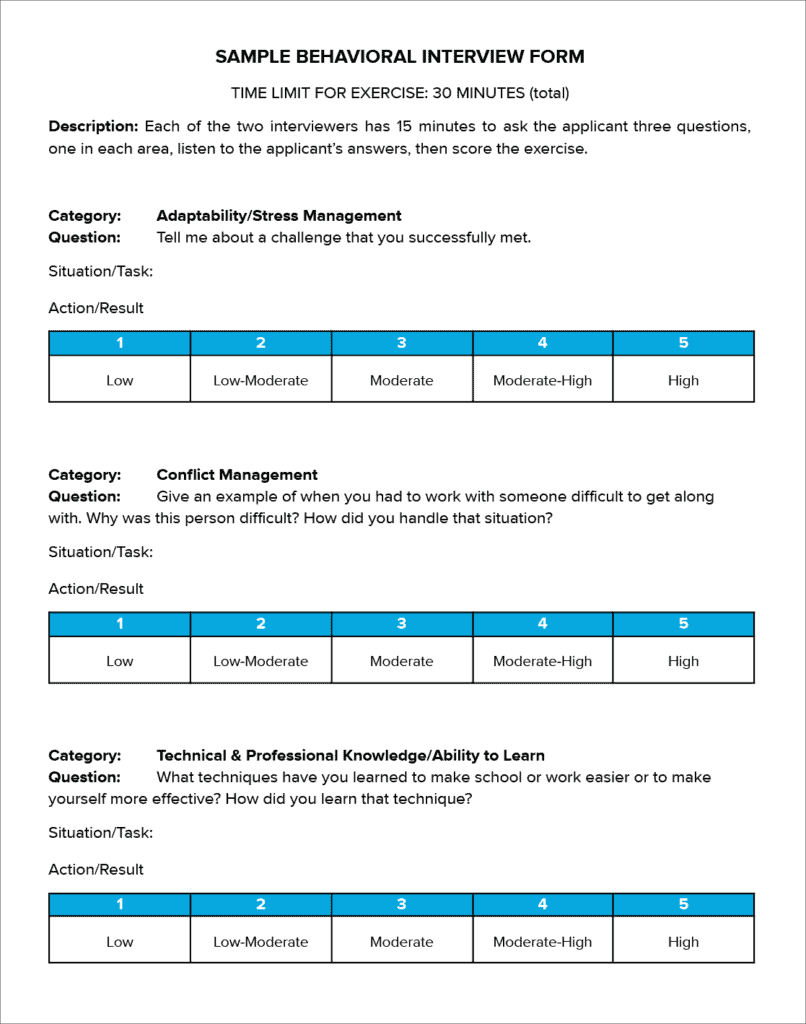
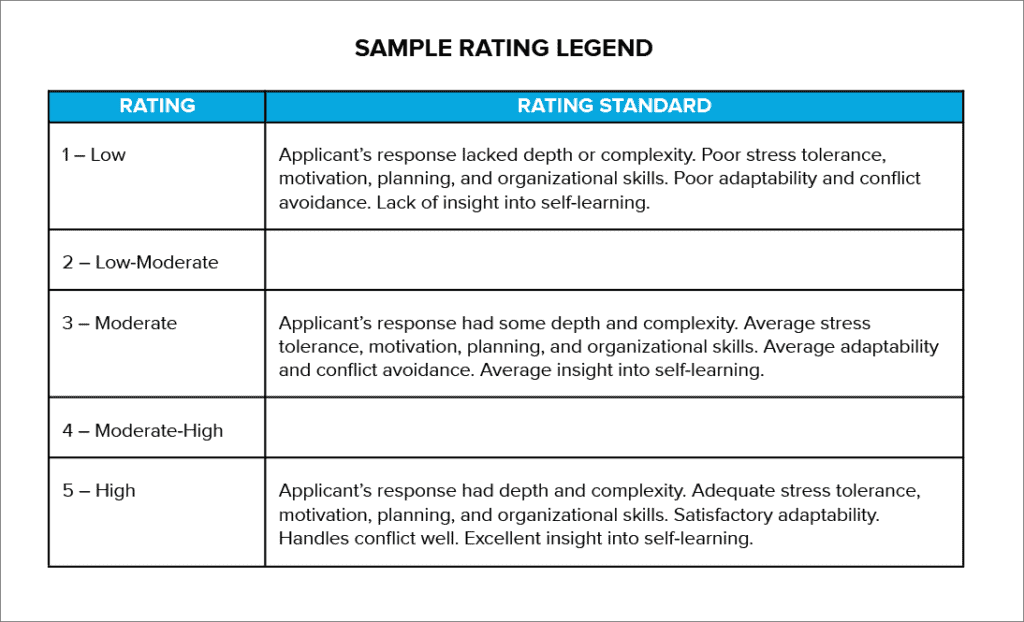
Here are some sample instructions for interviewers using behavioral questions. This provides the rationale for the questions and specific examples of implementing them within your program.


Behavioral Interviewing

Sample behavioral interview exercise:

  1. Ask the interviewee three behavioral interview questions.
  2. Grade the response of the question as low-moderate or high-level thinking process.
  3. Challenge: Identify the appropriate question based on the individual applicant. To help with this, each behavioral question is labeled with a category (e.g., adaptability/stress management). Choose one of the following questions and request that the interviewee provide the response.
  4. Tip: For a younger applicant with less life experience, choosing a question about the transition from high school to college might be pertinent. For a 30-year-old second-career applicant, choose a question about conforming to a policy.
  5. It is best to use two interviewers for breadth, then average the two scores.

Download and print the following form & legend here.


More Behavioral Questions

Below are examples of behavioral questions for the three main categories transferable and reproducible between interviewers. In our experience, there is significant inter-rater reliability when using this process.

Adaptability/Stress Management

  1. What was one of your most stressful experiences. How did you cope with it?
  2. How was your transition from high school to college? Did you face any particular problems?
  3. When did you have to adjust quickly to a change that you couldn’t control? How did that change impact you?
  4. When have you put your needs aside to help a coworker or classmate understand a task. How did you assist them? What was the result?
  5. How have you most constructively dealt with disappointment and turned it into a learning experience?
  6. When have you conformed to a policy even though you did not agree with it?


Conflict Management

  1. When did you come into conflict with another person and how did you handle the situation.
  2. When have you voiced a concern or disagreement to a coworker, supervisor, or professor? How did you manage the conflict? What was their reaction?
  3. When have you had to work with someone who was difficult to get along with? Why was this person difficult? How did you handle that person?
  4. What makes a boss, professor, or another authority figure them difficult to work with or to impress? How did you successfully interact with this person?
  5. When were you assigned to work with a person who did things very differently? How did you get the job done together?
  6. When were your results not up to your professor’s or supervisor’s expectations? What happened? What action did you take?


Technical & Professional Knowledge/Ability to Learn

  1. When have you used your technical expertise to solve a problem? What was the problem? How did you draw on your technical knowledge to solve it?
  2. Anyone can get overwhelmed. When have you had to request help or assistance on a project or assignment?
  3. When have you applied knowledge from previous coursework to a project in another class?
  4. When were you less than satisfied with your own performance? What did you do about it?
  5. How have you differed from your professors in evaluating your performance? How did you handle the situation?
  6. When have you had to learn something new in a short time. How did you proceed?


NEXT TIME…
In Issue 19 of PA Admissions Corner, we continue our series on Successful PA Admissions by looking into how group interviews can identify your program’s ideal applicants while identifying red-flag behaviors often displayed by applicants you want to avoid.


To your admissions and program success,

Jim Pearson, Former CEO
Exam Master

Dr. Scott Massey Ph.D., PA-C
Scott Massey LLC

Exam Master partners with PA programs by:

For information on any of the above products and/or services, contact us.

Meeting Enrollment Goals Part 1: The 72-Hour Rule and the 80/20 Rule

Successful PA Admissions Part 3: Group Interviewing

ISSUE 19

Successful PA Admissions Part 3: Group Interviewing

By Jim Pearson and Dr. Scott Massey

Welcome back to PA Admissions Corner as we continue our in-depth examination of Successful PA Admissions, which can be accomplished by finding your ideal applicants. Last time, we talked about the value of behavioral interviewing questions. Today we’ll take that knowledge further by discussing how group interviews can save you and your program from missing terrific applicants and how they can help you recognize red-flag behaviors.


The Group Interview Format

Three applicants/students participate in this group interview exercise. Each interviewer will observe each of the students and grade them according to their overall performance. The interviewers will time the question responses and limit the group conversation to 10-15 minutes.


Group Interview Exercise Samples

Here are some group interview question samples that can promote ideas, debate, and conversation among the participants.

Problem: Over lunch, you observe two PA students talking about how stressed they are with exams and the challenging material being covered. You also feel the stress of the program. To add to the students’ stress, they feel like the professors are not grading the projects fairly. Take the actions that you as a group feel most appropriate.

Problem: You are a PA student rotating in a family practice office. Your collaborating physician is very busy with a double-booked schedule. You are seeing a patient who recently received a diagnosis of lung cancer. The family practice physician discusses referral to an oncologist. The patient becomes visibly upset, but the preceptor doesn’t seem to notice. The preceptor walks toward the door, quickly summarizing the diagnosis and probable treatment, including chemotherapy. The preceptor asks you to speak to the patient about the diagnosis and provide any assistance possible. Provide a plan of action about how you would interact with the patient. Include a summary about how you might speak to the preceptor regarding your thoughts involving the preceptor’s interaction with the patient.

Problem: You are a first-year PA student in a mentorship under a practicing PA, who provides the oversight for your experience. Over the first few weeks, you notice some erratic behavior. The PA has been late several times. They look like they have not changed their clothes since the day before. On one such day, you note that the PA is groggy and slurring their words. You notice a smell of alcohol on their breath. As a group, discuss how you would respond to the situation.

Problem: You are first-year PA student taking Clinical Medicine I (5 credit hours). This course has vast volumes of content that you must assimilate and master in a short time. Based on your past academic experience, strategize as a group how you would collaborate to maximize the synergistic learning experience by drawing on each other’s strengths. Be specific about strategies.

Problem: You are studying with your team members when one of your classmates walks up and begins a conversation. They are currently at a psychiatric facility for a behavioral medicine rotation. They share details about a very unusual patient case admitted to this facility. The patient is having active hallucinations seeing animals crawling on the walls. This classmate admits to you that they have placed information about this case on their blog that chronicles their experience as a PA student. As a group, come up with an action plan about how you would proceed regarding this situation.


The Grading Legend

When scoring the interviews, strong contribution is the most positive. Applicants who score in this area received between 16-20 points. Moderate contributors receive 10-15 points.

Be sure not to penalize quiet or introverted applicants only because they speak less than their fellow group members. More socially inclined speakers always draw the most attention, but don’t assume that a lack of assertiveness means a lack of interest or intelligence. Some people are deep thinkers who don’t waste words, speaking little unless they feel they have something important to say. They speak more softly and less forcefully, but their answers will likely be carefully considered, taking more viewpoints into account. They are often agile negotiators who make subtle but useful contributions to a group dynamic. The value of their contributions is not based on the volume of their voice.

Another motive for subjecting applicants to a group interview is the opportunity to take particular note when applicants display red-flag behaviors: negative domination of the conversation/ideas, withdrawing or sulking, interrupting others, criticizing, or grandstanding. Observing these behaviors is enormously important because they indicate types of undesirable behavior that this applicant can bring with them as your student.

Interviewers document each question for each participant. They will choose from the following lists for the most appropriate attribute when observing the applicants in the group setting.

Strong Contribution Factors (+2 points for each) – the applicant displayed characteristics that make them an excellent choice for the program.

  • Manages conflict effectively
  • Demonstrates leadership skills within the group
  • Encourages and harmonizes the involvement of others in the group
  • Summarizes the problem effectively and provides a solution
  • Articulates with others and involves them in the conversation
  • Offers ideas about solutions
  • Probes effectively

Moderate Contribution Factors (+1 point for each) – the applicant displayed characteristics that make them an average choice for the program.

  • Supports team goals but does not identify them directly
  • Listens well but does not initiate conversations
  • Responds to ideas positively but does not lead conversation
  • Listens actively
  • Provides input about solutions but does not volunteer solutions directly

Distractors/Poor Contribution Factors (-1 point each) – the applicant displayed characteristics that make them unfit for the program. If you observe any of these red-flag behaviors, we strongly recommend removing the applicant from consideration.

  • Blocks others
  • Goes off-topic
  • Exhibits aggression
  • Dominates negatively
  • Interrupts others
  • Withdraws/remains silent
  • Criticizes
  • Insults others
  • Grandstands

We include the “Distractors” category in the hopes that it will not need to be used. In a group interview setting, we expect applicants to generally behave well, and at most we might see some signs of nervousness or anxiety. That’s natural; interviews are a stressful situation, after all. Interrupting another applicant can happen accidentally, and nerves or excitement can cause certain things to sound unintentionally aggressive. If the applicant apologizes or adjusts their behavior effectively, then there isn’t a problem. Consistent displays of counterproductive behavior, however, must be identified.

Anecdotally, applicants who display these troubling behaviors during group interviews cause the most problems during their studies. Aggression, immaturity, competitiveness, and inability to take instruction make things difficult for their instructors and classmates. High academic records and other commendations can obscure these warning signs to your detriment.

The group interview is your opportunity to accomplish two goals:

  1. Learn who your applicants are, how they interact with each other, and their intuitiveness, thoughtfulness, and maturity. These are things you won’t learn from a GPA or a resume.
  2. Detect if an applicant lacks the maturity and diplomacy to be an effective PA student, and eventually, a PA professional who represents your institution in the real world.


NEXT TIME…
In our next Issue of PA Admissions Corner, we’ll continue our series on Successful PA Admissions by looking at expanding diversity and inclusion. We’ll focus on ARC-PA Standard A1.11, which guides the demonstration of an institution’s commitment to student, faculty, and staff diversity and inclusion. We’ll discuss how you can use this standard to gain the support of your institution to meet the mission and vision of your program.


To your admissions and program success,

Jim Pearson, Former CEO
Exam Master

Dr. Scott Massey Ph.D., PA-C
Scott Massey LLC

Exam Master partners with PA programs by:

For information on any of the above products and/or services, contact us.

Privacy Overview

This website uses cookies so that we can provide you with the best user experience possible. Cookie information is stored in your browser and performs functions such as recognising you when you return to our website and helping our team to understand which sections of the website you find most interesting and useful.